
Pass ACFE Exams on first attempt with the help of our proxy services or our guaranteed exam questions and answers, We can pass the exam on your behalf, if you are not sure of passing the exam on your own, when working with us, there's no chance for failure. Contact Us Today, cfe exam prep in Venezuela.
CFE Exam Prep 2026–2027: Complete Study Guide, Preparation Tips & Exam Strategies
Last Updated: November 9, 2026
Are you preparing for the Certified Fraud Examiner (CFE) examination? Proper CFE exam preparation is essential for developing the knowledge, confidence, and practical skills needed to pass the examination and earn your professional certification.
The Certified Fraud Examiner (CFE) credential is awarded by the Association of Certified Fraud Examiners (ACFE). It is an internationally recognised professional qualification for individuals working in fraud prevention, detection, investigation, auditing, accounting, compliance, and risk management.
Whether you are a first-time candidate or preparing to retake an examination section, having a structured study plan can make a significant difference.
In this comprehensive CFE exam prep guide for 2026–2027, we cover the updated examination format, study materials, preparation strategies, practice questions, study schedules, and important tips to help you succeed.
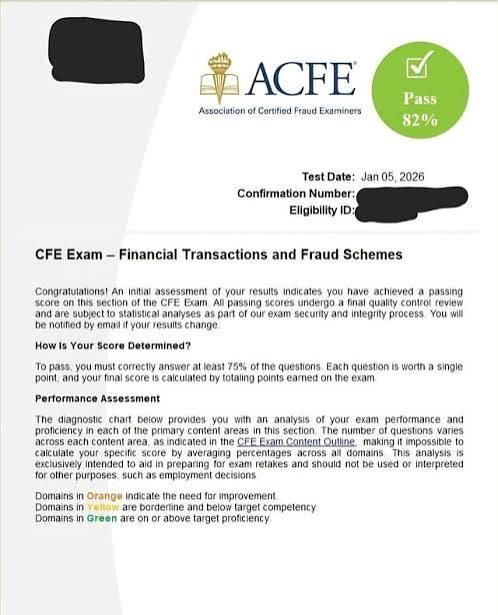
1. What Is the CFE Examination?
The CFE examination evaluates candidates' understanding of fraud examination principles and their ability to apply professional knowledge to fraud-related situations.
The examination is designed to assess knowledge in three main sections:
- Fraud Schemes and Financial Crimes.
- Fraud Investigations and Legal Issues.
- Fraud Prevention and Deterrence.
ACFE introduced an updated CFE examination in June 2026. Therefore, candidates preparing for the 2026–2027 examination should use the latest official examination outline and preparation materials.
2. CFE Exam Format 2026–2027
Understanding the examination structure is the first step toward effective preparation.
The updated CFE examination consists of three separate examination sections.
| Examination section | Main focus |
|---|---|
| Fraud Schemes and Financial Crimes | Occupational fraud, financial crimes, corruption, and fraudulent financial activities |
| Fraud Investigations and Legal Issues | Investigation methods, evidence, interviewing, and legal considerations |
| Fraud Prevention and Deterrence | Internal controls, fraud risk management, prevention, and ethical practices |
Each section is computer-based and must be completed in a separate sitting.
Candidates should consult the current ACFE Candidate Handbook for the latest examination duration, question format, passing requirements, and other testing policies.
3. How to Prepare for the CFE Examination
A successful preparation strategy requires more than simply reading study materials.
Candidates should combine conceptual learning, practical examples, revision, and practice questions.
Step 1: Understand the examination syllabus
Start by reviewing the official CFE examination content outline.
Identify the subjects covered in each examination section and understand the learning objectives.
Divide the syllabus into smaller topics to make your preparation more manageable.
Step 2: Use official ACFE study materials
Official ACFE preparation resources should form the foundation of your study plan.
These resources help candidates understand the examination topics and the professional knowledge expected of a Certified Fraud Examiner.
Avoid relying exclusively on outdated third-party notes, especially because the examination was updated in June 2026.
Step 3: Create a realistic study timetable
Develop a study timetable that covers all three examination sections.
Allocate more preparation time to topics you find difficult.
A consistent daily study routine is generally more effective than attempting to study everything shortly before your examination. cfe exam prep in Venezuela.
Step 4: Practise examination questions
Practice questions help you understand how examination concepts may be applied in different situations.
After answering each question:
- Review the correct answer.
- Understand why alternative answers are incorrect.
- Identify knowledge gaps.
- Revisit difficult concepts.
- Record recurring mistakes.
Step 5: Revise regularly
Regular revision helps reinforce important concepts.
Prepare short notes covering fraud schemes, investigation techniques, legal principles, and internal control procedures.
Review these notes throughout your preparation period.
4. Best Study Materials for CFE Exam Prep
Choosing appropriate preparation resources is important for examination success.
Consider the following resources.
Official ACFE CFE Exam Prep Course
The official ACFE preparation resources are designed to help candidates understand the examination content and develop their fraud examination knowledge.
Visit the official website to explore available preparation options:
CFE Candidate Handbook
The Candidate Handbook provides important information about eligibility, examination procedures, policies, and testing requirements.
Candidates should review the latest edition before scheduling their examination.
ACFE Study Resources
Use official study materials that correspond to the updated 2026 examination.
Practice Questions and Mock Examinations
Practice questions can help you assess your knowledge and identify areas that need further revision.
Use reliable resources that reflect the current examination outline.
5. CFE Exam Preparation: Section-by-Section Study Guide
A structured approach to each examination section can help you organise your preparation.
Section 1: Fraud Schemes and Financial Crimes
This section focuses on understanding different types of fraud and financial crime.
Important areas to study include:
- Occupational fraud.
- Asset misappropriation.
- Corruption.
- Financial statement fraud.
- Fraudulent disbursements.
- Money laundering.
- Fraudulent financial transactions.
- Other financial crime schemes.
Preparation tip: Study how different fraud schemes operate, how they may be detected, and which controls can help identify suspicious activities.
Section 2: Fraud Investigations and Legal Issues
This section focuses on the principles and methods used when investigating suspected fraud.
Important preparation areas include:
- Fraud investigation procedures.
- Interviewing techniques.
- Evidence collection.
- Document examination.
- Digital evidence considerations.
- Investigation reports.
- Legal principles.
- Professional responsibilities.
Preparation tip: Focus on understanding investigation procedures and the importance of collecting, preserving, and evaluating evidence appropriately.
Section 3: Fraud Prevention and Deterrence
This section examines strategies organisations can use to reduce fraud risks.
Important topics include:
- Internal controls.
- Fraud risk assessments.
- Corporate governance.
- Fraud prevention programmes.
- Ethical culture.
- Employee awareness.
- Fraud detection systems.
- Risk management procedures.
Preparation tip: Learn how organisations can design effective controls, identify weaknesses, and establish procedures to prevent fraudulent activities.
6. CFE Exam Study Plan: 30-Day Preparation Schedule
A 30-day study schedule can help candidates organise their preparation.
The following is an illustrative intensive study plan for candidates who already have a foundation in the subject matter.
| Study period | Preparation activities |
|---|---|
| Days 1–5 | Fraud Schemes and Financial Crimes |
| Days 6–10 | Fraud Investigations and Legal Issues |
| Days 11–15 | Fraud Prevention and Deterrence |
| Days 16–20 | Practice questions and topic revision |
| Days 21–25 | Mock examinations and weak-area review |
| Days 26–28 | Full syllabus revision |
| Days 29–30 | Final review and examination readiness |
Candidates who are new to fraud examination may benefit from a longer preparation period.
The schedule should also account for professional commitments, previous experience, and individual learning requirements.
7. CFE Exam Prep: Important Study Tips
Here are some practical strategies to improve your examination preparation.
1. Study consistently
Set aside dedicated study time each day instead of relying on last-minute revision.
2. Understand concepts rather than memorising answers
Fraud examination requires an understanding of how fraud schemes work and how investigations should be conducted.
3. Focus on difficult topics
Identify subjects where your understanding is weak and dedicate additional time to them.
4. Use practice questions regularly
Practise questions after completing each topic to assess your understanding.
5. Review mistakes carefully
Understanding why an answer is incorrect can be just as important as knowing the correct answer.
6. Avoid outdated materials
The CFE examination was updated in June 2026. Confirm that your study resources reflect the current syllabus.
7. Prepare for each examination section separately
Develop a study plan that allows you to focus on one section at a time while regularly reviewing previously covered material.
8. Sample CFE Exam Practice Questions
Practice questions can help you understand important fraud examination concepts.
The following are original illustrative questions for revision. They are not actual ACFE examination questions.
Question 1: Asset Misappropriation
Which of the following is an example of asset misappropriation?
A. Recording fictitious revenue.
B. An employee stealing cash from an organization.
C. Falsifying financial statements to improve reported profits.
D. Concealing a conflict of interest.
Correct answer: B
Explanation: Asset misappropriation involves the theft or misuse of an organization's resources.
Question 2: Fraud Prevention
Which control can help reduce the risk of unauthorized payments?
A. Eliminating payment approvals.
B. Allowing one employee to control the entire payment process.
C. Implementing segregation of duties.
D. Removing transaction monitoring.
Correct answer: C
Explanation: Segregation of duties reduces the opportunity for one individual to initiate, approve, and complete an unauthorized transaction.
Question 3: Fraud Investigation
What is an important objective when collecting evidence during a fraud investigation?
A. Altering original documents.
B. Preserving evidence integrity.
C. Destroying irrelevant records without review.
D. Sharing confidential evidence publicly.
Correct answer: B
Explanation: Preserving evidence integrity supports the reliability and credibility of an investigation.
Question 4: Financial Statement Fraud
Which of the following may indicate financial statement fraud?
A. Properly documented expenses.
B. Accurate inventory records.
C. Unusual revenue recognition practices.
D. Regular independent audits.
Correct answer: C
Explanation: Unusual or inappropriate revenue recognition may indicate an attempt to manipulate reported financial performance. cfe exam prep in Venezuela.
Question 5: Fraud Risk Management
What is the primary purpose of a fraud risk assessment?
A. To eliminate every possible business risk.
B. To identify and evaluate potential fraud risks.
C. To replace internal auditing.
D. To remove all management responsibilities.
Correct answer: B
Explanation: Fraud risk assessments help organisations identify vulnerabilities and develop appropriate prevention and detection measures.
9. Common Mistakes to Avoid During CFE Exam Preparation
Candidates sometimes struggle because of ineffective preparation methods.
Avoid these common mistakes:
- Studying without reviewing the official examination outline.
- Depending entirely on memorisation.
- Ignoring difficult examination topics.
- Using outdated preparation resources.
- Practicing questions without reviewing explanations.
- Underestimating the importance of investigation and legal concepts.
- Leaving revision until the final few days.
- Scheduling examination appointments before being adequately prepared.
A structured preparation strategy can help reduce these problems.
10. How Long Does It Take to Prepare for the CFE Examination?
Preparation time varies according to professional experience, academic background, and familiarity with fraud examination concepts.
Some candidates may be comfortable with an intensive 30-day preparation programme, while others may need 60–90 days or longer.
A reasonable preparation approach is to:
- Review the entire examination syllabus.
- Complete the recommended study materials.
- Practise questions for all three sections.
- Revise weaker topics.
- Assess examination readiness before scheduling.
The most important factor is the quality and consistency of preparation rather than the number of days spent studying.
11. CFE Exam Scheduling and Eligibility Period
After your CFE application has been approved, you can activate your examination eligibility.
The standard examination eligibility period is 60 days after activation.
Candidates must schedule and complete all required examination sections within this period.
The international CFE examination follows a continuous testing arrangement, subject to appointment availability.
Depending on the applicable arrangements, candidates can choose:
- Remote online proctoring.
- In-person examination at an authorised Prometric testing centre.
Preparation tip: Complete most of your study before activating your 60-day eligibility period. This gives you more flexibility when choosing examination appointments.
12. Frequently Asked Questions About CFE Exam Prep
Q1. How do I prepare for the CFE examination?
Start by reviewing the official examination outline, studying ACFE preparation materials, creating a timetable, practicing questions, and revising difficult topics.
Q2. How many sections are in the CFE examination?
The updated examination consists of three sections: Fraud Schemes and Financial Crimes, Fraud Investigations and Legal Issues, and Fraud Prevention and Deterrence.
Q3. How many days should I study for the CFE exam?
Preparation time varies. Some experienced candidates may use a 30-day intensive plan, while others may benefit from 60–90 days or longer.
Q4. Are practice questions important for CFE exam preparation?
Yes. Practice questions help assess knowledge, identify weaknesses, and improve your understanding of examination concepts.
Q5. Can I prepare for the CFE examination while working full-time?
Yes. A structured timetable with consistent daily study sessions can help working professionals balance preparation with employment responsibilities.
Q6. What is the best CFE exam preparation material?
Official ACFE preparation resources and the latest Candidate Handbook should form the foundation of your preparation.
Q7. Has the CFE examination changed in 2026?
Yes. ACFE introduced an updated examination in June 2026. Candidates should use current study materials and the latest examination content outline.
Q8. What is the passing score for the CFE examination?
Candidates must achieve at least 75% in each of the three examination sections. Consult the latest Candidate Handbook for the applicable examination policies.
Q9. Can I take the CFE examination online?
Yes. Remote proctoring is available through the authorised Prometric platform, subject to technical and examination requirements.
Q10. Where can I find official CFE exam preparation resources?
Visit the official ACFE website at https://www.acfe.com/ and navigate to the CFE examination and preparation sections.
Conclusion: Start Your CFE Exam Preparation Today
Preparing for the Certified Fraud Examiner examination requires dedication, structured learning, and a clear understanding of fraud examination principles.
By studying the updated examination syllabus, using official ACFE preparation resources, practicing questions, and following a realistic study schedule, you can build the knowledge and confidence needed to approach the examination.
Whether you are an accountant, auditor, compliance professional, investigator, or aspiring fraud examiner, the CFE credential can be a valuable addition to your professional qualifications.
Start your preparation today, review your progress regularly, and work toward achieving your Certified Fraud Examiner certification.
Prepare strategically. Practise consistently. Take the next step toward becoming a Certified Fraud Examiner.
Official website: https://www.acfe.com/
CFE Exam Preparation, CFE Study Guide, Certified Fraud Examiner Exam, CFE Practice Questions