
Pass GRE Exam on first attempt with the help of our proxy services or our guaranteed exam questions and answers, We can pass the exam on your behalf, if you are not sure of passing the exam on your own, when working with us, there's no chance for failure. Contact Us Today to get gre at home in United Kingdom.
GRE at Home in Romania: Complete Guide to Taking the GRE Exam Online from Malaysia
Are you planning to pursue a master's degree, PhD, MBA, or other postgraduate qualification overseas? Preparing for the Graduate Record Examination (GRE) is an important step for students applying to universities around the world.
The good news is that you do not necessarily need to travel to an examination center to take the GRE. With the GRE at Home, eligible candidates can complete their examination from the comfort of their own home using a computer and a reliable internet connection.
The GRE at Home offers greater flexibility and convenience, making it an attractive option for Malaysian students who want to prepare for international postgraduate education.
In this guide, we explore everything you need to know about the GRE at Home, including its examination format, eligibility, technical requirements, registration process, test-day procedures, and preparation tips.
1. What Is the GRE at Home?
The GRE at Home is an online version of the GRE General Test administered by the Educational Testing Service (ETS).
It allows eligible candidates to take the GRE from home or another suitable private location instead of travel ling to an authorized examination center.
The online examination has the same:
- Examination content.
- Question types.
- Duration.
- Scoring system.
- General test format.
As with the test-center examination, the GRE at Home is monitored by a human online proctor to maintain examination security and ensure that candidates follow the official testing rules.
The examination is available around the clock, seven days a week, subject to appointment availability and eligibility.
For Malaysian students, this can be a convenient alternative to taking the examination at a physical test center.
2. Who Should Take the GRE at Home?
The GRE at Home is suitable for students and professionals planning to apply for postgraduate programmes internationally.
You may consider this examination option if you:
- Are applying for a master's degree overseas.
- Intend to pursue a PhD or doctoral program.
- Are applying to selected MBA or business school programmes.
- Prefer taking examinations in a familiar environment.
- Live far from an authorized GRE test center.
- Want greater flexibility when choosing an examination appointment.
However, before registering, make sure your intended university accepts GRE scores and that the at-home testing option is available for your location.
3. GRE at Home Examination Format
The GRE General Test at Home follows the same examination structure as the test-center version.
The examination takes approximately 1 hour and 58 minutes and consists of three sections.
A. Analytical Writing
This section evaluates your ability to communicate ideas effectively and develop logical arguments.
Candidates complete one task called Analyze an Issue.
You will be assessed on:
- Critical thinking.
- Argument development.
- Logical reasoning.
- Written communication.
B. Verbal Reasoning
The Verbal Reasoning section measures your ability to understand written information and analyze relationships between words and concepts.
It includes:
- Reading comprehension.
- Text completion.
- Sentence equivalence.
A strong English vocabulary and regular reading practice can help you prepare for this section.
C. Quantitative Reasoning
This section evaluates your mathematical reasoning and problem-solving abilities.
The main topics include:
- Arithmetic.
- Algebra.
- Geometry.
- Data analysis.
- Quantitative comparison.
Candidates should practice solving mathematical problems accurately while managing their examination time effectively.
4. Technical Requirements for the GRE at Home
One of the most important steps before registering for the GRE at Home is checking whether your computer and examination environment meet ETS requirements.
Computer Requirements
Candidates generally need:
- A desktop or laptop computer.
- A supported and licensed operating system.
- A working internet connection.
- A compatible webcam.
- A working microphone.
- Internal or external speakers.
Tablets, mobile phones, Chromebooks, and multiple-monitor setups are not permitted as the main examination computer.
Headphones and earphones are also prohibited during the examination.
Candidates should download the ETS Secure Browser and complete the official equipment check before examination day.
Internet Connection
A stable internet connection is essential throughout the examination.
Before your test:
- Check your internet speed and connection stability.
- Avoid using shared or congested networks where possible.
- Close unnecessary applications.
- Ask other household members to avoid activities that consume significant internet bandwidth.
- Disable remote-access and screen-sharing applications as required by ETS.
Camera and Microphone
Your webcam and microphone must function properly throughout the examination.
The webcam allows the proctor to monitor you, while the microphone enables communication with the examination supervisor.
Important 2026 update: ETS introduced a second-camera requirement for GRE at Home examinations effective 5 January 2026. Candidates should prepare a compatible smartphone or tablet with a working camera to provide an additional view of their testing area, following the official setup instructions.
5. GRE at Home Room and Environment Requirements
Apart from technical requirements, your examination room must comply with ETS security regulations.
Your testing environment should meet the following conditions:
Private Room
You must take the examination alone in a private room. Nobody else should enter the room during your test.
Quiet Environment
Choose a quiet location without unnecessary interruptions, background conversations, or excessive noise.
Proper Desk and Chair
Your computer and keyboard must be placed on a desk or suitable tabletop. You must sit on a standard chair rather than a bed or sofa.
Clear Examination Area
Remove unauthorized items, including:
- Books and study notes.
- Additional electronic devices.
- Unauthorized stationery.
- Personal recording equipment.
- Other prohibited materials.
Proper Lighting
Make sure your face and examination area are clearly visible to the proctor.
The room setup must also allow the proctor to inspect your surroundings and tabletop before the examination begins.
Candidates should review the official ETS room requirements carefully because failure to comply may result in being denied permission to take the examination.
6. How to Register for the GRE at Home
Registering for the GRE at Home is straightforward. Candidates can complete the process through the official ETS website.
Follow these steps:
Step 1: Create an ETS Account
Visit the official ETS GRE website and create an account using your personal details.
Make sure your registered name matches your accepted identification document.
Step 2: Select the GRE General Test
Choose the GRE General Test if you are applying for postgraduate programmes that require or accept this examination.
Step 3: Select the At-Home Option
Choose the GRE at Home option if it is available for your account location and intended examination date.
Step 4: Select Your Examination Date and Time
Choose an available appointment that fits your preparation schedule.
Step 5: Complete Payment
Pay the applicable examination registration fee using an accepted payment method.
Step 6: Prepare for Your Examination
After receiving your confirmation, review the technical requirements, complete your equipment check, and prepare your testing environment.
Step 7: Complete Identity Verification
ETS requires candidates to complete identity verification using its designated verification process. The current instructions recommend completing this at least 72 hours before the examination.
Official registration website:
7. What Happens on GRE at Home Test Day?
Knowing what to expect on examination day can help reduce stress and ensure a smoother testing experience.
Here is a general overview of the process.
Before the Examination
Before your scheduled appointment:
- Ensure your computer is fully charged or connected to a power source.
- Check your internet connection.
- Prepare your accepted identification document.
- Set up your smartphone or second camera as instructed.
- Close unnecessary applications.
- Clear your desk and surrounding area.
- Make sure your examination room is quiet and private.
During Check-In
Candidates should begin the check-in process approximately 15 minutes before their scheduled examination time.
You will be required to:
- Verify your identity.
- Connect with the online proctor.
- Show your examination room and desk.
- Complete the required camera checks.
- Follow the proctor's instructions.
The check-in process typically takes around 20–30 minutes.
During the Examination
Once the examination begins, the proctor will monitor your examination session.
You must follow the official testing rules throughout the examination.
Remember:
- Do not leave the camera's view.
- Do not communicate with other people.
- Do not use unauthorized materials.
- Do not access prohibited applications or websites.
- Do not take unscheduled breaks.
The GRE General Test at Home takes approximately 1 hour and 58 minutes, with no scheduled breaks.
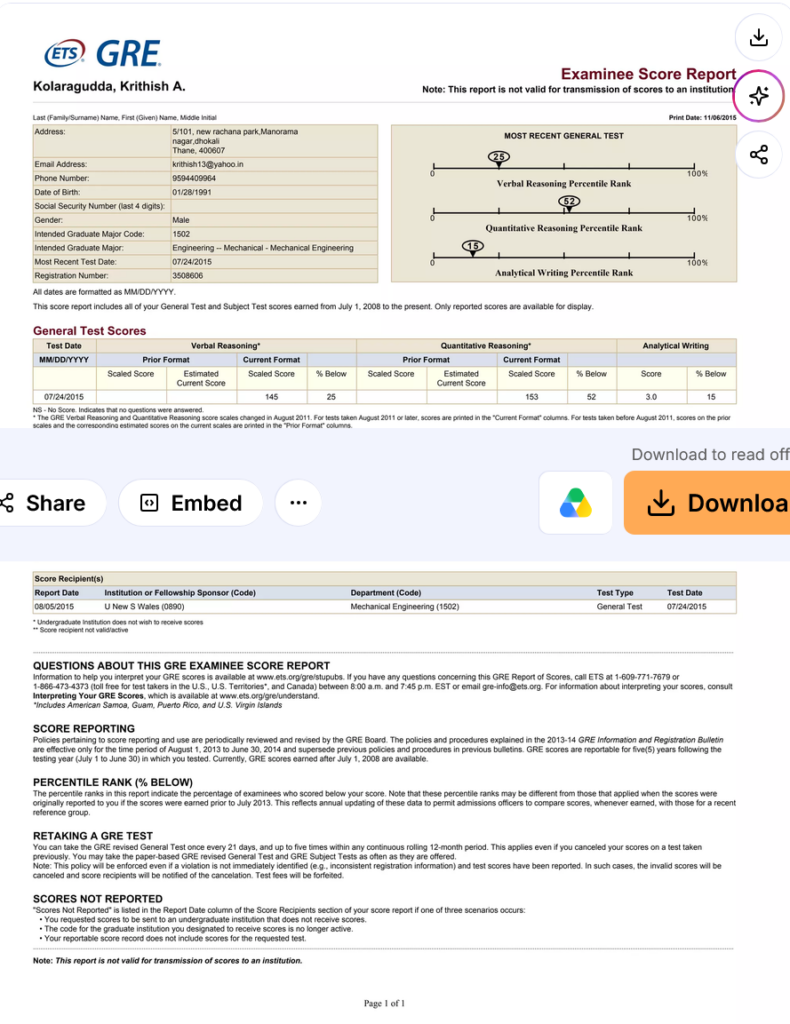
8. GRE at Home Scoring System
The GRE at Home uses the same scoring system as the GRE examination taken at a test center.
| Examination Section | Score Range |
|---|---|
| Verbal Reasoning | 130–170 |
| Quantitative Reasoning | 130–170 |
| Analytical Writing | 0–6 |
The combined Verbal and Quantitative Reasoning score ranges from 260 to 340.
Candidates can view their unofficial Verbal and Quantitative scores after completing the examination.
Official results, including the Analytical Writing score, are generally available in the ETS account within 8–10 days.
Your GRE scores are valid for five years after the examination date.
9. Advantages of Taking the GRE at Home
There are several reasons why students choose the GRE at Home rather than travel ling to a physical examination center.
Convenience
You can take the examination from your own home without travel ling to a testing location.
Flexible Scheduling
The GRE at Home offers appointment availability throughout the week, including weekends, subject to available slots.
Comfortable Environment
Taking the examination in a familiar environment may help some candidates feel more comfortable and focused.
Save Traveling Time
Students who live far from authorized examination centres can avoid additional travel ling arrangements.
Same GRE Scoring System
The at-home examination follows the same scoring system as the test-center examination, so candidates do not need to worry about a separate scoring scale.
10. GRE at Home vs GRE at a Test Center
Not sure which examination option is right for you? Here is a comparison.
| Feature | GRE at Home | GRE Test Centre |
|---|---|---|
| Examination format | Computer-based | Computer-based |
| Examination content | Same | Same |
| Scoring system | Same | Same |
| Location | Private approved location | Authorised test centre |
| Proctoring | Online human proctor | On-site supervision |
| Scheduling | Flexible appointments | Centre availability |
| Travel required | No | Yes |
| Technical preparation | Required | Centre equipment provided |
Both options offer the same GRE General Test and scoring system.
Your decision should depend on your personal preferences, available facilities, and ability to meet the examination requirements.
11. Preparation Tips for the GRE at Home
Preparing for the GRE requires more than understanding the examination syllabus. You must also become familiar with the online examination environment.
Here are some useful preparation strategies.
1. Take Official GRE Practice Tests
Use official ETS practice materials to understand the question formats, difficulty levels, and examination timing.
2. Practice Time Management
Develop a strategy for answering questions within the allocated time.
3. Strengthen Your English Vocabulary
Read English-language academic articles and practice vocabulary exercises to improve your Verbal Reasoning performance.
4. Improve Your Mathematics Skills
Review arithmetic, algebra, geometry, and data analysis regularly.
5. Practice Analytical Writing
Work on structuring your essays with clear arguments, supporting examples, and logical conclusions.
6. Simulate the At-Home Environment
Practice using a computer in a quiet room without unnecessary interruptions.
7. Complete Your Equipment Check Early
Do not wait until examination day to check your webcam, microphone, speakers, internet connection, and computer compatibility.
8. Prepare Your Second Camera
Familiarize yourself with the additional camera setup introduced in 2026 to avoid unnecessary technical difficulties during check-in.
12. Frequently Asked Questions About the GRE at Home
Q1: Can I take the GRE at Home in Malaysia?
The GRE at Home is offered in locations where the GRE is normally available, based on the country associated with your ETS account. Malaysian candidates should check eligibility and appointment availability directly through ETS before registering.
Q2: Is the GRE at Home easier than the test-center examination?
No. Both versions have the same examination content, format, and scoring system.
Q3: Is the GRE at Home monitored?
Yes. A human online proctor monitors the examination through your camera, microphone, and computer screen.
Q4: Can I use a laptop for the GRE at Home?
Yes. Candidates can use an eligible desktop or laptop computer that meets ETS technical requirements. Tablets and mobile phones cannot be used as the main examination device.
Q5: Can I use headphones during the GRE at Home?
No. Headphones and earphones are not permitted. You must use internal or external speakers and a separate microphone.
Q6: Do I need a second camera for the GRE at Home?
Yes. Under the requirements effective from 5 January 2026, candidates must prepare a compatible smartphone or tablet as a second camera and follow ETS setup instructions.
Q7: Can I take the GRE at Home on weekends?
Yes. Appointments are available throughout the week, including weekends, subject to availability.
Q8: How long does the GRE at Home take?
The GRE General Test takes approximately 1 hour and 58 minutes, excluding the check-in process.
Q9: Are GRE at Home scores accepted by international universities?
The GRE at Home uses the same examination and scoring system as the test-center version. However, applicants should always confirm the GRE requirements and accepted testing arrangements with their chosen universities.
**Q10: What happens if my internet