
Pass Project Management Exams on first attempt with the help of our proxy services or our guaranteed exam questions and answers, We can pass the exam on your behalf, if you are not sure of passing the exam on your own, when working with us, there's no chance for failure. Contact Us Today, pmp certification course in Saudi Arabia .
PMP Certification Course: Complete Guide to Training, Fees, Eligibility, and Exam Preparation in 2026
Introduction
Are you planning to build a successful career in project management? A PMP certification course can be an important step toward achieving your professional goals.
The Project Management Professional (PMP) certification, offered by the Project Management Institute (PMI), is one of the most recognized credentials in the project management industry. It validates your ability to lead teams, manage complex projects, control budgets, handle risks, and deliver successful business outcomes.
Whether you work in IT, construction, engineering, finance, healthcare, or business operations, completing a structured PMP certification course can help you develop practical project management skills and prepare for the PMP certification examination.
In this comprehensive guide, we will explain everything you need to know about PMP certification courses, including course content, eligibility requirements, training options, fees, preparation strategies, and career opportunities.
What Is a PMP Certification Course?
A PMP certification course is a professional training program designed to prepare candidates for the Project Management Professional certification examination.
These courses help learners understand project management frameworks, leadership techniques, project planning, risk management, Agile methodologies, and business strategy.
Most PMP preparation programs include:
- Project management fundamentals.
- Project planning and scheduling.
- Cost and budget management.
- Risk and quality management.
- Stakeholder engagement.
- Team leadership and communication.
- Agile and hybrid project management.
- Project monitoring and control.
- PMP examination preparation and practice questions.
A good PMP certification course should combine theoretical knowledge with real-world project management scenarios.
Important: Completing a PMP training course does not automatically make you PMP-certified. You must meet PMI's eligibility requirements, apply for the examination, and pass it.
Why Should You Enroll in a PMP Certification Course?
Investing in PMP training can provide several professional benefits.
1. Improve Your Project Management Skills
PMP training helps you understand how to manage projects from initiation to completion. You learn how to develop project plans, allocate resources, manage deadlines, and deliver measurable results.
2. Increase Your Career Opportunities
Organizations across industries need qualified project managers who can lead teams and successfully execute business initiatives.
PMP certification can strengthen your professional profile when applying for positions such as:
- Project Manager
- Senior Project Manager
- Program Manager
- IT Project Manager
- Project Coordinator
- Project Management Consultant
- PMO Manager
3. Develop Leadership and Communication Skills
Managing a project involves more than creating schedules and tracking budgets. Project managers must communicate with stakeholders, resolve conflicts, motivate teams, and make important decisions.
A PMP course helps you develop these essential leadership capabilities.
4. Gain International Recognition
PMP certification is recognized by employers worldwide. It can help demonstrate your project management knowledge and professional commitment across different industries and geographical markets.
5. Prepare for the PMP Examination
A structured course provides organized study materials, practice questions, mock examinations, and guidance to help you understand the examination format.
What Will You Learn in a PMP Certification Course?
A comprehensive PMP certification course should cover the knowledge and skills outlined in PMI's current PMP Examination Content Outline.
The 2026 PMP examination focuses on three major domains.
1. People
This domain focuses on the human and leadership aspects of project management.
Topics include:
- Team development and management.
- Conflict resolution.
- Stakeholder engagement.
- Leadership and motivation.
- Communication management.
- Team performance.
- Collaboration and decision-making.
2. Process
This domain focuses on the technical activities required to manage projects successfully.
Topics include:
- Project planning and execution.
- Scope management.
- Schedule management.
- Budget and cost management.
- Quality management.
- Risk management.
- Resource allocation.
- Project monitoring and control.
- Agile and hybrid delivery approaches.
3. Business Environment
This domain examines how projects contribute to organizational objectives and business value.
Topics include:
- Business strategy alignment.
- Organizational change.
- Benefits realization.
- Governance and compliance.
- Sustainability.
- Business value delivery.
- Emerging technologies, including AI.
The 2026 examination weighting is:
| Exam domain | Weight |
|---|---|
| People | 33% |
| Process | 41% |
| Business Environment | 26% |
A quality PMP training course should reflect these updated examination requirements.
PMP Certification Course Eligibility Requirements
Before enrolling in a PMP certification program, it is important to understand the eligibility criteria.
Under PMI's July 2026 requirements, candidates must meet one of the following education and experience pathways:
| Educational qualification | Project leadership experience |
|---|---|
| High school diploma or equivalent | 60 months |
| Associate degree or eligible vocational qualification | 48 months |
| Bachelor's degree or higher | 36 months |
| Bachelor's or postgraduate degree from a PMI GAC-accredited program | 24 months |
The qualifying project experience must have been accumulated within the previous 10 years.
Candidates must also complete 35 hours of eligible project management training or hold an active CAPM certification.
Always check PMI's official eligibility guidance before submitting your application.
Online vs. Classroom PMP Certification Course
One of the most important decisions is choosing the right training format.
Online PMP Certification Course
Online PMP training is ideal for working professionals who need flexibility.
Benefits include:
- Study from any location.
- Flexible learning schedules.
- Recorded training sessions.
- Access to digital learning materials.
- Self-paced examination preparation.
- Opportunities to revisit difficult topics.
Classroom PMP Certification Course
Classroom training offers direct interaction with instructors and other learners.
Benefits include:
- Structured learning schedules.
- Live instructor guidance.
- Group discussions.
- Real-world project examples.
- Immediate feedback.
- Collaborative learning opportunities.
Which Option Should You Choose?
If you have a busy professional schedule, an online PMP certification course may be the most convenient option.
If you prefer direct interaction and structured learning, instructor-led classroom training may be more suitable.
When choosing live training, pay attention to PMI's updated provider requirements effective December 1, 2026.
How to Choose the Best PMP Certification Course
Not all PMP training programs offer the same quality. Before enrolling, consider the following factors.
1. Updated Course Curriculum
Choose a program aligned with the July 2026 PMP Examination Content Outline.
Avoid courses that rely exclusively on outdated examination materials.
2. Qualified Instructors
Look for instructors with practical project management experience and a strong understanding of PMP examination requirements.
3. 35-Hour Training Certificate
Ensure that the course provides documentation confirming completion of the required 35 hours of project management education.
4. Practice Tests and Mock Examinations
A good training program should include practice questions and full-length mock examinations.
These help identify knowledge gaps and improve examination readiness.
5. Study Materials
Look for courses that provide:
- Downloadable study materials.
- Recorded lessons.
- Revision notes.
- Practice questions.
- Real-world case studies.
- Examination strategies.
6. Training Provider Recognition
Check whether the provider is a PMI Authorized Training Partner (ATP), particularly if you intend to take live instructor-led training after December 1, 2026.
How Much Does a PMP Certification Course Cost?
The cost of PMP training varies depending on the training provider, learning format, instructor experience, and included study resources.
Your overall certification budget may include:
- PMP training fees.
- PMI membership fees, if applicable.
- PMP examination fees.
- Practice examination resources.
- Additional learning materials.
- Potential examination retake fees.
PMP examination fees are separate from training fees and may vary according to membership status and location.
Before purchasing a course, compare the total package rather than considering tuition alone.
How Long Does It Take to Complete a PMP Certification Course?
The duration depends on the training format and learning schedule.
Many PMP preparation programs are structured around the required 35 hours of project management education.
However, completing the training is only one part of the preparation process.
A practical study plan could look like this:
| Preparation activity | Suggested duration |
|---|---|
| Complete PMP training | 2–4 weeks |
| Study examination topics | 3–4 weeks |
| Practice questions | 2 weeks |
| Mock examinations and revision | 2 weeks |
This is an illustrative 8–12-week preparation schedule, not a mandatory PMI requirement.
Your actual preparation time will depend on your existing knowledge, experience, and available study hours.
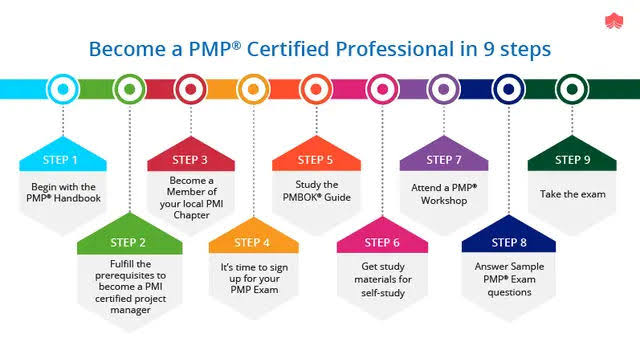
Step-by-Step Process to Get PMP Certified
Follow these steps to work toward your PMP certification.
Step 1: Check Your Eligibility
Review your educational qualifications and project leadership experience against PMI's requirements.
Step 2: Enroll in a PMP Certification Course
Choose an appropriate training program that meets the required education hours and aligns with the current examination outline.
Step 3: Complete Your Training
Attend your classes or complete your online lessons. Keep your training completion documentation.
Step 4: Apply Through PMI
Create your PMI account and submit your PMP application with your education and project experience details.
Step 5: Prepare for the Examination
Review the examination content outline, complete practice questions, and take mock examinations.
Step 6: Schedule Your Examination
After your application is approved, follow PMI's instructions to schedule your examination.
Step 7: Pass the PMP Examination
Demonstrate your project management knowledge and decision-making skills by passing the examination.
Step 8: Maintain Your Certification
Earn the required Professional Development Units (PDUs) and renew your certification according to PMI's renewal requirements.
Career Opportunities After Completing a PMP Certification Course
PMP training and certification can help professionals pursue opportunities across multiple industries.
Some popular career paths include:
Project Manager: Responsible for planning, coordinating, and delivering projects within defined objectives.
Senior Project Manager: Leads complex projects and coordinates multiple teams and stakeholders.
Program Manager: Oversees related projects to achieve broader organizational goals.
IT Project Manager: Manages software development, infrastructure, technology implementation, and digital transformation projects.
PMO Manager: Supports project governance, standards, reporting, and portfolio oversight.
Project Management Consultant: Advises organizations on improving project delivery, processes, and performance.
Your career opportunities and salary potential will depend on your experience, location, industry, and responsibilities.
Is an Online PMP Certification Course Worth It?
Yes, an online PMP certification course can be a valuable investment for professionals who want flexible and structured examination preparation.
It allows you to learn project management concepts while continuing your professional responsibilities.
However, selecting the right course is essential.
Make sure the program:
- Covers the current PMP examination outline.
- Provides the required training hours.
- Includes practice questions and mock examinations.
- Offers comprehensive learning materials.
- Provides clear documentation of course completion.
A well-designed course can help you build confidence and develop the knowledge required for the PMP examination.
Frequently Asked Questions About PMP Certification Courses
1. What is the best PMP certification course?
The best PMP course is one that follows PMI's current examination content outline, provides eligible 35-hour training, offers experienced instruction, and includes practice examinations.
PMI's official PMP exam preparation program is a good starting point.
2. Can I complete a PMP certification course online?
Yes. Online, self-paced PMP courses are available from various training providers and can be completed according to your schedule.
3. Is 35 hours of PMP training mandatory?
Candidates generally need 35 hours of eligible project management education or an active CAPM certification to satisfy the training requirement.
4. Can beginners enroll in a PMP course?
Yes. Anyone can study project management through a training course. However, completing a course does not guarantee eligibility for the PMP examination. Candidates must satisfy PMI's experience requirements.
5. How long should I study for the PMP exam?
Many candidates plan approximately two to three months for structured preparation, although individual requirements vary.
6. Does a PMP training course guarantee certification?
No. A training course helps prepare you for the examination but does not guarantee that you will pass or receive the certification.
7. What is the difference between PMP training and PMP certification?
PMP training provides the knowledge and education required for examination preparation. PMP certification is the professional credential awarded by PMI after a candidate meets the eligibility requirements and passes the examination.
8. Can I get a job after completing a PMP certification course?
A PMP course can improve your knowledge and professional profile. However, employment depends on your qualifications, experience, skills, and the requirements of individual employers.
Conclusion
A PMP certification course is a valuable learning opportunity for professionals who want to strengthen their project management skills and advance their careers.
From project planning and risk management to team leadership and business strategy, PMP training provides a structured approach to understanding modern project management practices.
Whether you choose online learning or instructor-led classroom training, make sure your course meets PMI's education requirements and follows the latest 2026 examination content.
Start by checking your eligibility, selecting a suitable training program, and creating a realistic study plan.
Invest in your project management skills today and take the next step toward becoming a Project Management Professional.