
Pass ACFE Exams on first attempt with the help of our proxy services or our guaranteed exam questions and answers, We can pass the exam on your behalf, if you are not sure of passing the exam on your own, when working with us, there's no chance for failure. Contact Us Today, cfe exam accounting in Spain.
cfe exam accounting in Spain: Complete Study Guide, Topics, Examples & Practice Questions (2027)
Last Updated: November 2027
Accounting is an important subject for candidates preparing for the Certified Fraud Examiner (CFE) examination. Understanding accounting principles, financial statements, cash flows, and financial statement fraud helps candidates recognize suspicious transactions and identify potential financial misconduct.
The Certified Fraud Examiner credential is awarded by the Association of Certified Fraud Examiners (ACFE). It is designed for professionals specializing in fraud prevention, detection, investigation, and deterrence.
If you are preparing for the CFE examination and want to understand the accounting concepts tested, this guide covers the essential topics, practical examples, financial formulas, and sample questions you should know.
In this guide, you will learn:
- Basic accounting concepts.
- The accounting equation.
- Balance sheets and income statements.
- Statements of cash flows.
- Cash accounting versus accrual accounting.
- Financial statement fraud.
- Financial statement analysis.
- Important accounting ratios.
- CFE-style practice questions.
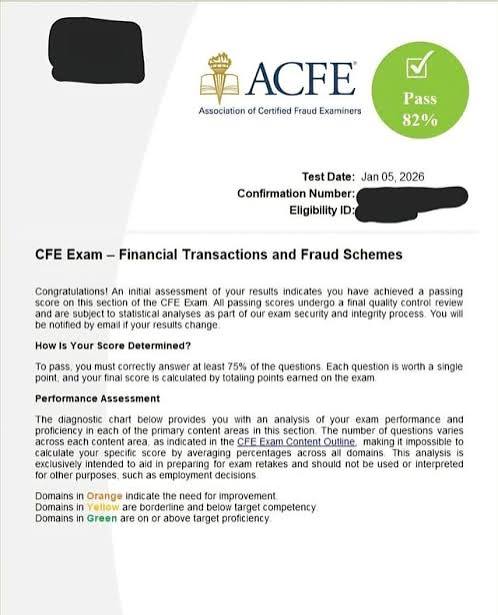
1. Is Accounting Included in the CFE Exam?
Yes. Accounting is included in the first section of the updated CFE examination, called Fraud Schemes and Financial Crimes.
The accounting-related examination content includes two specific domains:
| Examination domain | Percentage of exam | Questions |
|---|---|---|
| Accounting Concepts | 6% | 7 |
| Financial Statement Fraud | 4% | 5 |
| Combined | 10% | 12 |
These figures refer to the full examination, not just the first section.
The Accounting Concepts domain evaluates your understanding of financial statements, accounting methods, and accounting frameworks.
The Financial Statement Fraud domain examines how financial information can be intentionally manipulated and how analytical techniques can help identify irregularities.
Both areas are important for understanding how fraud affects an organization's financial records.cfe exam accounting in Spain.
2. Basic Accounting Concepts for the CFE Exam
Before studying financial statement fraud, you should understand the basic principles of accounting.
Accounting is the process of recording, classifying, summarizing, and reporting financial transactions.
The main purpose is to provide useful financial information about an organization.
A. The Accounting Equation, cfe exam accounting in Spain
One of the most important accounting formulas is:
Assets = Liabilities + Equity
This equation represents the fundamental relationship between what a business owns, what it owes, and the owner's residual interest.
Assets
Assets are economic resources controlled by an organization.
Examples:
- Cash.
- Accounts receivable.
- Inventory.
- Buildings.
- Equipment.
- Investments.
Liabilities
Liabilities represent obligations that an organization owes to other parties.
Examples:
- Accounts payable.
- Bank loans.
- Salaries payable.
- Taxes payable.
- Bonds payable.
Equity
Equity represents the residual interest in the assets of an organization after deducting liabilities.
Examples:
- Share capital.
- Retained earnings.
- Additional paid-in capital.
Practical example:
A company has:
- Assets: $500,000.
- Liabilities: $200,000.
- Equity: $300,000.
The accounting equation is:
$500,000 = $200,000 + $300,000
The equation balances.
Understanding this relationship helps fraud examiners recognize financial inconsistencies.
B. Debit and Credit, cfe exam accounting in Spain.
Double-entry accounting requires every transaction to affect at least two accounts.
The basic debit and credit rules are:
| Account type | Increase | Decrease |
|---|---|---|
| Assets | Debit | Credit |
| Liabilities | Credit | Debit |
| Equity | Credit | Debit |
| Revenue | Credit | Debit |
| Expenses | Debit | Credit |
Example:
A company purchases office equipment for $5,000 in cash. cfe exam accounting in Spain.
The accounting entry is:
| Account | Debit | Credit |
|---|---|---|
| Equipment | $5,000 | |
| Cash | $5,000 |
The equipment asset increases, while the cash asset decreases.
Total assets remain unchanged.
C. Revenue and Expenses
Revenue represents income earned from an organization's normal business activities.
Examples include:
- Sales revenue.
- Service revenue.
- Consulting revenue.
- Rental revenue.
Expenses represent the costs incurred to generate revenue and operate the business.
Examples include:
- Salaries.
- Rent.
- Utilities.
- Advertising.
- Insurance.
- Depreciation.
The difference between revenue and expenses determines profit or loss.
Net Profit = Total Revenue − Total Expenses
For example:
Revenue = $100,000
Expenses = $70,000
Net Profit = $30,000
3. Understanding the Three Main Financial Statements
The CFE examination expects candidates to understand the main components of financial statements and how they relate to each other.
The three primary financial statements are:
- Balance Sheet.
- Income Statement.
- Statement of Cash Flows.
A. Balance Sheet, cfe exam accounting in Spain.
The balance sheet, also called the statement of financial position, shows an organization's financial position at a specific point in time.
It contains three main categories:
- Assets.
- Liabilities.
- Equity.
Example: Balance Sheet
| Assets | Amount |
|---|---|
| Cash | $20,000 |
| Accounts receivable | $30,000 |
| Inventory | $50,000 |
| Equipment | $100,000 |
| Total assets | $200,000 |
| Liabilities and Equity | Amount |
|---|---|
| Accounts payable | $30,000 |
| Bank loan | $70,000 |
| Shareholders' equity | $100,000 |
| Total liabilities and equity | $200,000 |
The balance sheet must satisfy the accounting equation.
CFE examination tip: Understand the difference between current assets, non-current assets, current liabilities, and long-term liabilities. cfe exam accounting in Spain.
B. Income Statement
The income statement measures an organization's financial performance over a period of time.
It includes revenue, expenses, and profit or loss.
Example: Income Statement
| Description | Amount |
|---|---|
| Sales revenue | $200,000 |
| Cost of goods sold | $120,000 |
| Gross profit | $80,000 |
| Operating expenses | $40,000 |
| Operating profit | $40,000 |
| Interest and taxes | $10,000 |
| Net profit | $30,000 |
Important formulas:
Gross Profit = Revenue − Cost of Goods Sold
Operating Profit = Gross Profit − Operating Expenses
Net Profit = Total Revenue − Total Expenses
CFE examination tip: Understand the difference between revenue, gross profit, operating profit, and net profit.
C. Statement of Cash Flows
The statement of cash flows explains how cash enters and leaves an organization during a reporting period.
It contains three main activities.
1. Operating Activities
Cash generated or used by normal business operations.
Examples:
- Cash received from customers.
- Payments to suppliers.
- Employee salaries.
- Operating expenses.
2. Investing Activities
Cash related to purchasing or selling long-term assets and investments.
Examples:
- Purchasing equipment.
- Selling buildings.
- Acquiring investments.
- Selling property.
3. Financing Activities
Cash related to borrowing, repaying debt, and transactions with shareholders.cfe exam accounting in Spain
Examples:
- Receiving bank loans.
- Repaying loans.
- Issuing shares.
- Paying dividends.
Example:
| Cash flow activity | Amount |
|---|---|
| Operating activities | $50,000 |
| Investing activities | -$20,000 |
| Financing activities | $10,000 |
| Net increase in cash | $40,000 |
The statement of cash flows is especially useful when comparing reported profits with actual cash generated by a business.
4. Cash Accounting vs Accrual Accounting
Understanding the difference between cash and accrual accounting is an important CFE examination topic.
Cash Accounting, cfe exam accounting in Spain.
Under cash accounting, revenue is generally recognized when cash is received, and expenses are generally recognized when cash is paid.
Example:
A company provides services worth $10,000 in January but receives payment in February.
Under cash accounting, the revenue is generally recorded in February.
Accrual Accounting, cfe exam accounting in Spain.
Under accrual accounting, revenue is generally recognized when earned, and expenses are recognized when incurred, subject to applicable accounting standards.
Using the same example, the company records the $10,000 revenue in January when the services are provided and the revenue is earned.
Main Differences
| Cash accounting | Accrual accounting |
|---|---|
| Based on cash received and paid | Based on revenue earned and expenses incurred |
| Simpler accounting approach | More comprehensive financial reporting |
| Focuses on cash movements | Focuses on economic activity |
| May not show outstanding receivables | Recognizes accounts receivable |
CFE examination tip: Be able to identify when revenue and expenses should be recognized under each method.
5. Accounting Frameworks: GAAP and IFRS
The CFE examination also expects candidates to recognize the major accounting frameworks and understand where they are used.
GAAP, cfe exam accounting in Spain.
GAAP stands for Generally Accepted Accounting Principles.
In the United States, U.S. GAAP is established primarily through the Financial Accounting Standards Board (FASB).
It provides rules and guidance for preparing financial statements.
IFRS
IFRS stands for International Financial Reporting Standards.
These standards are developed by the International Accounting Standards Board (IASB).
They are used in many countries around the world.
GAAP vs IFRS
| GAAP | IFRS |
|---|---|
| U.S. accounting framework | International accounting framework |
| Primarily used in the United States | Used in many jurisdictions |
| Developed primarily by FASB | Developed by IASB |
| Detailed guidance in many areas | Principles-based framework in many areas |
Fraud examiners should understand that accounting treatments can differ between reporting frameworks.
When analyzing financial statements, it is important to identify which accounting framework applies.
6. Financial Statement Fraud
Financial statement fraud occurs when an organization intentionally misrepresents its financial information.
The objective may be to mislead investors, creditors, regulators, management, or other users of financial statements.
The updated CFE examination includes a specific domain covering Financial Statement Fraud.
The major categories include the following.
A. Revenue Manipulation, cfe exam accounting in Spain
Revenue manipulation occurs when an organization intentionally misstates its revenue.
Examples include:
- Recording revenue before it is earned.
- Recording fictitious sales.
- Recognizing revenue from transactions that do not meet applicable recognition criteria.
- Improperly recording sales returns or allowances.
Revenue manipulation can make an organization appear more profitable than it actually is.
B. Expense Manipulation
Expense manipulation involves intentionally misstating or concealing business expenses.
Examples include:
- Capitalizing expenses that should be recognized immediately.
- Omitting liabilities.
- Understating operating expenses.
- Improperly delaying expense recognition.
This can artificially increase reported profit.
C. Balance Sheet Manipulation
Balance sheet manipulation involves intentionally misrepresenting assets, liabilities, or equity.
Examples include:
- Overstating inventory.
- Recording fictitious receivables.
- Understating liabilities.
- Misrepresenting asset valuations.
D. Improper Disclosure
Improper disclosure occurs when an organization intentionally omits or misrepresents important information in its financial statements or accompanying disclosures.
Examples include:
- Failing to disclose material related-party transactions.
- Concealing significant liabilities.
- Misrepresenting contingent liabilities.
- Omitting important financial risks.
7. Financial Statement Analysis for Fraud Detection
Financial statement analysis helps fraud examiners identify unusual trends and relationships.
The CFE examination includes analytical techniques such as horizontal analysis, vertical analysis, and ratio analysis.
A. Horizontal Analysis
Horizontal analysis compares financial information across different reporting periods.
Formula:
Percentage Change = (Current Period − Previous Period) / Previous Period × 100
Example:
Revenue in 2025 = $100,000
Revenue in 2026 = $150,000
Percentage Change = ($150,000 − $100,000) / $100,000 × 100
Percentage Change = 50%
If revenue increases significantly without a corresponding increase in cash receipts or other expected business activity, further investigation may be appropriate.
B. Vertical Analysis
Vertical analysis expresses financial statement items as a percentage of a base amount.
For an income statement, revenue is commonly used as the base.
Example:
| Item | Amount | Percentage of Revenue |
|---|---|---|
| Revenue | $200,000 | 100% |
| Cost of goods sold | $120,000 | 60% |
| Operating expenses | $40,000 | 20% |
| Net profit | $30,000 | 15% |
Vertical analysis makes it easier to compare financial performance across different periods or organizations.
C. Ratio Analysis
Financial ratios help evaluate an organization's financial position and performance.
Important ratios include:
Current Ratio
Current Ratio = Current Assets / Current Liabilities
Measures the ability to meet short-term obligations.
Quick Ratio
Quick Ratio = (Current Assets − Inventory) / Current Liabilities
Measures short-term liquidity without relying on inventory sales.
Gross Profit Margin
Gross Profit Margin = Gross Profit / Revenue × 100
Measures the proportion of revenue remaining after cost of goods sold.
Net Profit Margin
Net Profit Margin = Net Profit / Revenue × 100
Measures how much net profit is generated from each unit of revenue.
Debt-to-Equity Ratio
Debt-to-Equity Ratio = Total Liabilities / Shareholders' Equity
Measures the relationship between liabilities and equity.
These ratios do not prove fraud by themselves. They help identify unusual financial relationships that may require additional examination.
8. Important Accounting Red Flags for CFE Candidates
Fraud examiners should understand the warning signs that may indicate financial statement manipulation.
Examples include:
- Revenue increasing significantly while cash collections remain weak.
- Unusual growth in accounts receivable.
- Inventory increasing much faster than sales.
- Significant changes in gross profit margins.
- Expenses declining without a reasonable business explanation.
- Large unexplained journal entries near the end of a reporting period.
- Significant differences between reported earnings and operating cash flow.
- Unusual transactions with related parties.
These indicators are not conclusive evidence of fraud. They should be evaluated alongside supporting documentation, business conditions, and other evidence.
9. How to Study Accounting for the CFE Exam
Accounting candidates may already understand many of these concepts. However, candidates from non-accounting backgrounds should spend additional time learning financial statements and basic accounting principles.
Here is a practical preparation strategy.
Week 1: Basic Accounting
Study:
- Accounting equation.
- Assets, liabilities, and equity.
- Debit and credit.
- Revenue and expenses.
- Double-entry accounting.
Week 2: Financial Statements
Study:
- Balance sheet.
- Income statement.
- Statement of cash flows.
- Cash accounting.
- Accrual accounting.
Week 3: Financial Statement Fraud
Study:
- Revenue manipulation.
- Expense manipulation.
- Balance sheet manipulation.
- Improper disclosures.
- Financial statement fraud indicators.
Week 4: Financial Analysis and Practice
Study:
- Horizontal analysis.
- Vertical analysis.
- Financial ratios.
- Accounting frameworks.
- Practice questions and revision.
Use the official 2026 CFE Exam Content Outline to make sure your preparation matches the current syllabus.
10. CFE Accounting Practice Questions and Answers
The following are original practice questions designed to help you understand important accounting concepts. They are not actual ACFE examination questions.
Question 1: Accounting Equation
A company has total assets of $800,000 and liabilities of $300,000.
What is the company's equity?
A. $300,000
B. $400,000
C. $500,000
D. $800,000
Correct Answer: C. $500,000
Explanation:
Equity = Assets − Liabilities
$800,000 − $300,000 = $500,000.
Question 2: Revenue Recognition
Under accrual accounting, when is revenue generally recognized?
A. When cash is received.
B. When revenue is earned.
C. When the annual financial statements are prepared.
D. When the customer pays the invoice.
Correct Answer: B. When revenue is earned.
Explanation:
Accrual accounting recognizes revenue when it is earned, subject to the applicable accounting standards, rather than simply when cash is received.
Question 3: Balance Sheet
Which of the following is classified as a liability?
A. Inventory.
B. Accounts receivable.
C. Accounts payable.
D. Equipment.
Correct Answer: C. Accounts payable.
Explanation:
Accounts payable represents amounts owed by a company to its suppliers.
Question 4: Financial Statement Fraud
A company records fictitious sales to increase reported revenue.
What type of financial statement fraud is this?
A. Expense manipulation.
B. Revenue manipulation.
C. Asset misappropriation.
D. Improper disclosure.
Correct Answer: B. Revenue manipulation.
Explanation:
Recording fictitious sales artificially increases reported revenue.
Question 5: Cash Flow
Which of the following is normally classified as an investing activity?
A. Paying employee salaries.
B. Receiving cash from customers.
C. Purchasing equipment.
D. Paying suppliers.
Correct Answer: C. Purchasing equipment.
Explanation:
Purchasing long-term assets such as equipment is generally an investing activity.
Question 6: Gross Profit
A company reports revenue of $500,000 and cost of goods sold of $300,000.
What is its gross profit?
A. $100,000.
B. $150,000.
C. $200,000.
D. $300,000.
Correct Answer: C. $200,000.
Explanation:
Gross Profit = Revenue − Cost of Goods Sold
$500,000 − $300,000 = $200,000.
Question 7: Current Ratio
A company has current assets of $240,000 and current liabilities of $120,000.
What is its current ratio?
A. 0.5.
B. 1.0.
C. 2.0.
D. 3.0.
Correct Answer: C. 2.0.
Explanation:
Current Ratio = Current Assets / Current Liabilities
$240,000 / $120,000 = 2.0.
Question 8: Financial Statement Analysis
Which analytical technique compares financial information across multiple reporting periods?
A. Vertical analysis.
B. Horizontal analysis.
C. Cost allocation.
D. Bank reconciliation.
Correct Answer: B. Horizontal analysis.
Explanation:
Horizontal analysis identifies changes in financial information over time.
11. Final Tips for Passing the CFE Accounting Topics
To prepare effectively for the accounting-related areas of the CFE examination:
- Understand the accounting equation.
- Learn the components of the three main financial statements.
- Know the difference between revenue and cash receipts.
- Understand cash and accrual accounting.
- Learn the differences between GAAP and IFRS.
- Memorize essential financial analysis formulas.
- Understand the main categories of financial statement fraud.
- Practice applying accounting concepts to fraud-related situations.
Remember that the CFE examination tests practical fraud examination knowledge, not just the ability to memorize accounting definitions.
12. Conclusion
Accounting is an important foundation for becoming an effective Certified Fraud Examiner.
Understanding financial statements, accounting principles, cash flows, financial ratios, and financial statement fraud helps candidates recognize unusual financial activities and understand how fraudulent transactions may affect an organization's financial records.
Although accounting represents a relatively small portion of the updated CFE examination, it is closely connected to the wider subject of fraud examination.
Start with the basic accounting principles, build your understanding of financial statements, and practice applying financial analysis techniques to fraud-related scenarios.
Ready to prepare for the CFE examination?
Visit the official ACFE website and review the latest examination content outline and study materials.
Official website: https://www.acfe.com/
Secondary Keywords:
- CFE Accounting Topics
- CFE Exam Accounting Questions
- Certified Fraud Examiner Accounting
- CFE Exam Study Guide
- Financial Statement Fraud
- Accounting Concepts for CFE
- ACFE Exam Preparation
- CFE Practice Questions
Suggested Tags: CFE Exam, Accounting Concepts, ACFE, Fraud Examination, Financial Statement Fraud, Accounting Study Guide, CFE Practice Questions